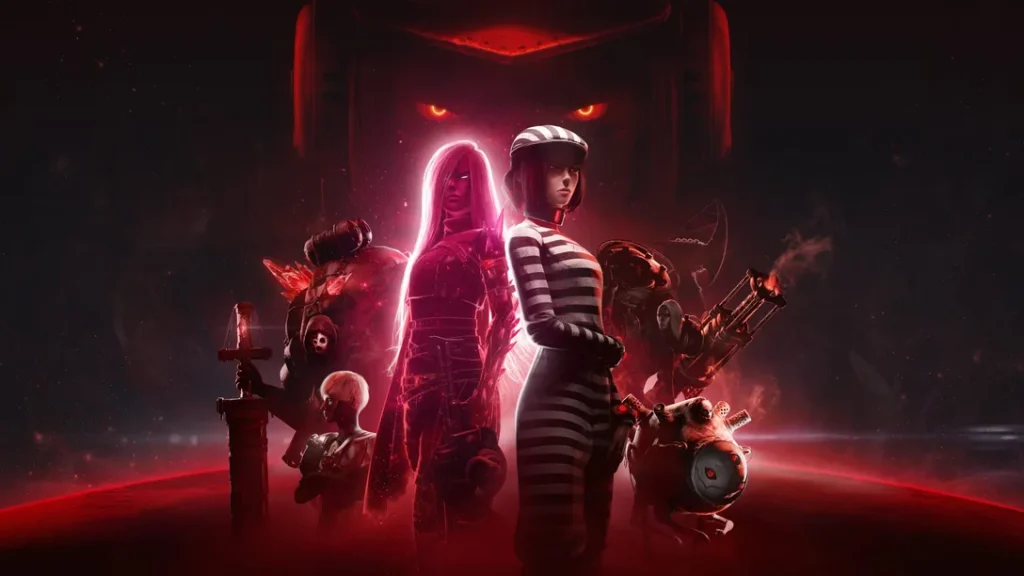
I touched on this in this post recently, but man is the serendipity of having a thought and then a game immediately coming along to pay off that thought a wonderful thing. This one’s tinged with more than a hint of tragedy, though, so buckle up for a lot of praise and then a little gut punch at the end.
Luna Abyss sorta peeked into my view while working at PlayStation, but the idea of a bullet hell FPS just didn’t hit for me. I want to be clear: it’s a fantastic idea, and done well, it’s the sort of thing I’d greenlight at a publisher while still feeling dubious of my own attraction to the finished product.
Yeah, uh, that’s not an issue with this game: FPS bullet hell isn’t entirely new, but this approach to it absolutely is, and it’s EXCEPTIONALLY my shit. I think I clocked a total of 10 or so hours through the game, though my feeble old man bones forced a dump down to just before the “entirely turn off damage/skip puzzles” difficulty mode.
That no-damage option IS a mode, by the way, and it’s one example of just how dope this game is at taking something that is exceptionally twitchy, switchy and shifty and making it palatable not just for those with slowing reflexes, but accessible too. Props to developer Kwalee Labs for resisting the urge to lean into controller-breaking difficulty, even if that’s certainly closer to the default.
Head/Space
Before I delve into the core gameplay, I should make mention of the game’s approach to story. The setup is simple: a giant moon-sized (and shaped) red object suddenly appears above earth and effectively upends everything we knew about the universe. Exploration of the seemingly infinite space inside this alien moon results in new forms of energy, extended lifespans for humanity and, of course, a whole new religion surrounding this honkin’ planetoid just up and appearing out of nowhere.
You play an inmate (dubbed “Fawkes” upon arrival by the absolute gargantuan head-on-a-snake-body that takes up a large portion of your cell) sent to the moon to plumb its depths. Given an impossible 9000+ day sentence, successfully diving into the mysterious and impossible space of the Abyss by way of linking up with androids that exist inside the moon means a reduction in sentence.
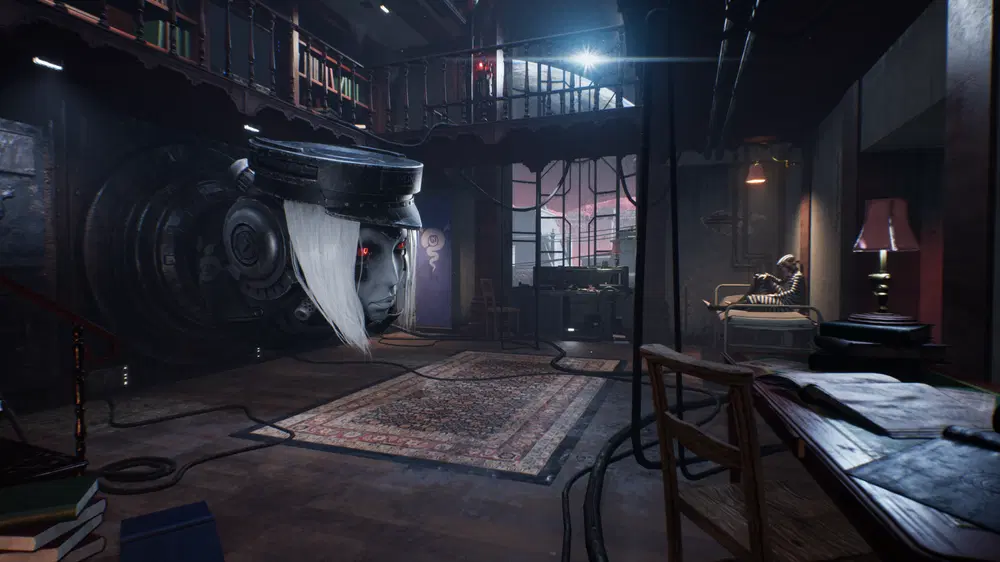
That’s basically it. Do what the warden of this prison says, eat away at the sentence, go home. Of course, things quickly start to get spooky and unfathomably weird in the Abyss thanks to a mysterious set of signals and an encroaching sort of viral biomass that caused almost the entire civilization that inhabited the Abyss to die off, both of which sort of tell a story from either end of a truth that sits in the middle, steadily chipped away at via logs that help (very) slowly peel away the layers surrounding the central narrative nugget that kicked off this desolation.
Luna Abyss’ character designs are wild to say the least. I can honestly say I’ve never encountered beings with these kinds of distorted limbs or mask-like visages. True to Kwalee Labs’ UK location, voice actors give all these lanky fusions of organica and machinery a suitably staid delivery and personality. After all, when you’ve been in a place for hundreds of years, you tend to become a bit taciturn about existence.
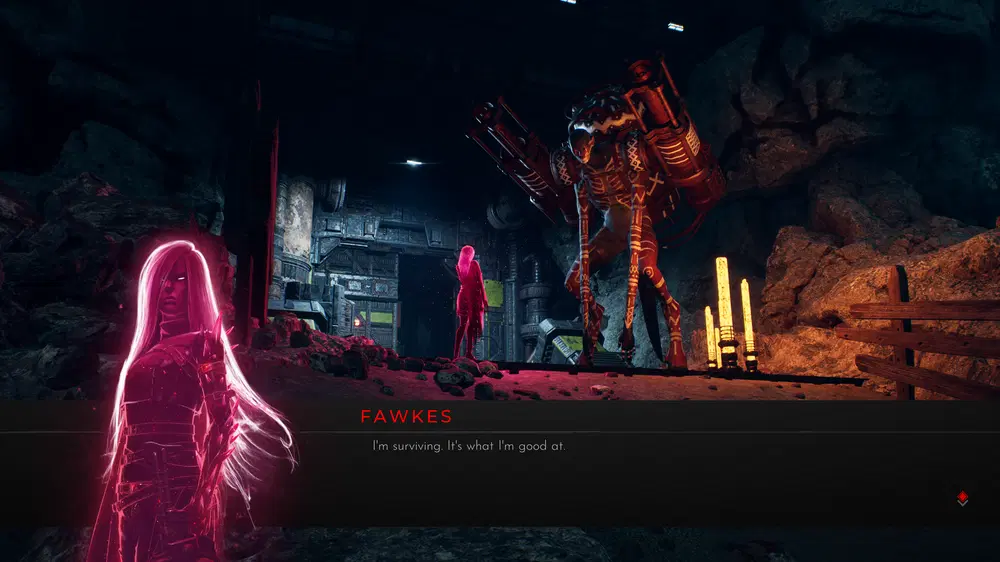
These freaky characters intersect with an incredible world, too. The art style is a sort of spoon-thick smoothie that evokes the tastes (if not the literal influence) of H.R. Geiger’s contours (minus all the constant genitalia everywhere), Zdzislaw Beksinki’s jutting mega-structures (without everything being made of bones) and plenty of techno-religious imagery just to round things out (especially as the game goes on). It all gives everything a kind of bleak sense that you’re experiencing a world LONG after it’s crumbled into post-post-post-apocalyptical decay, and it pairs perfectly with the written logs and the utter capitulation in the voices of those with whom you can still interact.
This isn’t mere window dressing, either; Kwalee Labs built a deep repository of lore to digest at your own pace. The codex offers a stupefying level of thought and polish while still keeping things both perfectly paced in terms of what they reveal vis-a-vis the ongoing story, but also in hiding mysteries that need to stay hidden. Good authors know the big reveal is never as good as what you’ve built up in your mind, and these entries are all carefully cultivated and measured to reveal real certain names, or to place things chronologically (though the entries themselves often aren’t), or to just add a sense of actual emotion, no matter how prideful, uplifting, dour or, often, utterly bleak these final records tend to be.
This is actually my most coveted literary trick: the after-fact breadcrumb is the most potent way to re-tread what you’ve already learned and understand it was never the full picture. Often, though, it’s too obvious. Sometimes it’s self-congratulatingly obtuse. Usually things lean in the former (thankfully), but this one’s got the stuff; by the time it’s over, the game knows you’ve been paying attention without becoming a lore cannon or a catch-up session; if you know, you know more, and that is just a delicious sensation as player. It might be my absolute favorite one.
Dodge, Duck, Dip, Dive and… Dodge
Luna Abyss’ Gameplay is an almost a 50/50 mix of dash-and-double-jump platforming and bullet hell battles. New abilities, weapons and corresponding platforming wrinkles – along with a broadening suite of enemy types to use them on – are constantly doled out. The pacing of new upgrades, and the expansion of more advanced platforming requirements gives the scaffolding of movement places to grow and expand in ways that feel entirely natural.
By the end of the game, you’re not even thinking about how you double-jumped between moving platforms, air-dashed through a barrier, slid under lasers and swapped between weapon types in the span of 30 or so seconds; you just… did it, and that’s because the game’s built up this LEGO-style set of muscle memory building blocks to turn you into a little bullet hell kunoichi.
It’s all extremely Housemarque-coded – to the point where this feels distinctly like something that could have lived in whatever shared mental space created Returnal and Saros, albeit without the same level of ultra-bleak barely-staved-defeatism that permeates those worlds, right down to the radiating patterns of projectiles that are spawned by enemies and color-coded vulnerabilities that require some deft switching of weapons to punch through barriers, nullify some types of attacks or pop shields of your own.
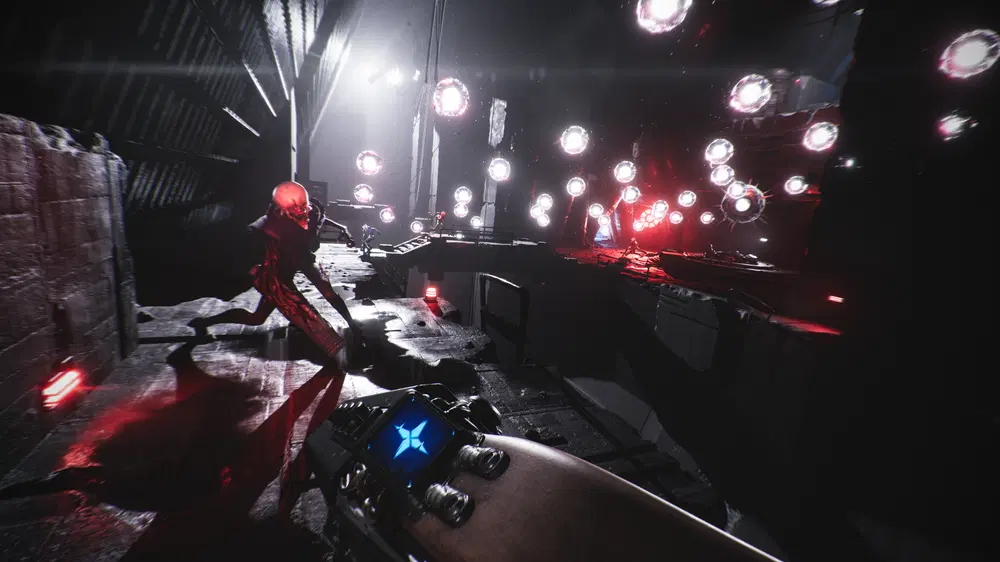
So combat eventually becomes a swiss army knife-style right tool/right enemy dance that lets you attack encounters in the order you choose based on what weapon you want to hot swap to while weaving between incoming shots. There’s a bit of the most recent DOOM games in there (though you’re not nearly as agile until late in the game, and most shots can’t be dashed through), but in the same way the platforming keeps adding new tricks to your bag, combat has you increasingly using the d-pad to toggle between weapons to tackle specific enemy types during steadily ramping arena battles.
Neither part of this gameplay split – combat nor platforming – would work if the controls weren’t immediately tight and responsive. There’s a floaty smoothness to everything when you’re in the air that immediately feels Bungie-esque, particularly the Destiny games. Controls are snappy, but with generous, delightfully tuned dead zones. You can make quick changes in direction, but you’re not going to be twitching yourself off platforms.
A Quick Aside…
The concept of a bullet-hell anything exists with a basic understanding that you can always see when stuff’s coming and avoid it. When the genre was born as top-down, 2D shooters in Japan…
Let’s shunt for a second into a talk about coin-op shooters that built this industry – stuff that even people too old or young to fully comprehend the impact these kinds of games have had on society – the Centipedes or Galagas or 1942s when they started scrolling the background and let the player roam around the level to avoid shots from more angles. As hardware got better, so did the visuals and the complexity of shootouts started getting dizzying, but at least fairly patterned so as not to be unfair.
Then came bullet hell. With their 1993 genre-definer Batsugun, Japanese studio Toaplan decided to consciously fill the screen with projectiles, but did so in patterns that made dodging between them as much of the gameplay as actually shooting all the enemies that were spitting them out. (This was brilliantly fucked with on a fundamental level with Ikaruga by shooter developer Treasure on Dreamcast – go play that; it’s been ported to most modern systems.)The idea is you’re constantly juggling dodging incoming fire while trying to position yourself to return fire of your own, and it’s a far more delicate balance than that simple explanation would imply. When done right, you feel like you’re one with the controls and conscious thought falls away. The number of developers that understand the tightrope act of challenge vs. fairness, though, are few and far between.
Whoa
I mentioned the art style of the game (think near-monochrome tunnels early on that are bathed in reds and blues when not almost greyscale slowly giving way to something approaching an actual set of hues, never a full color palette), but the particular ways Luna Abyss plays with scale – particularly in the Luna Mines section, which is just unfathomably huge (albeit mostly in an out-of-reach way) – is genuinely jaw-dropping.
Often this is paired not just with moments of incomprehensible scale, but lighting-traversing elements that showcase the game’s use of dynamic shadows in breathtaking gloominess – think things like swinging pillars or, in one particular instance, an entire being that’s just sitting motionless on a suspended, pendulous platform that cast thick, mood-altering chunks of shadow that dance over every surface.
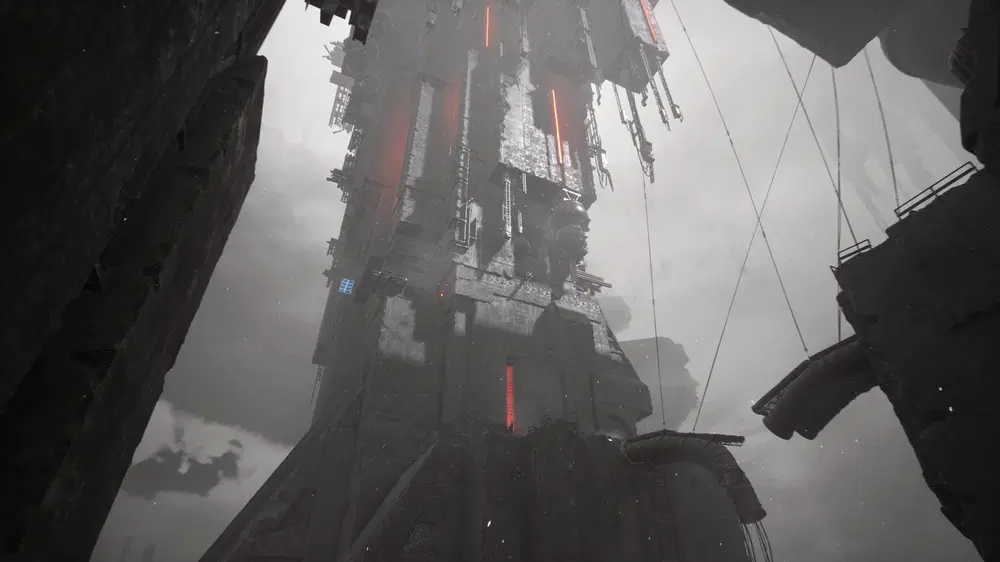
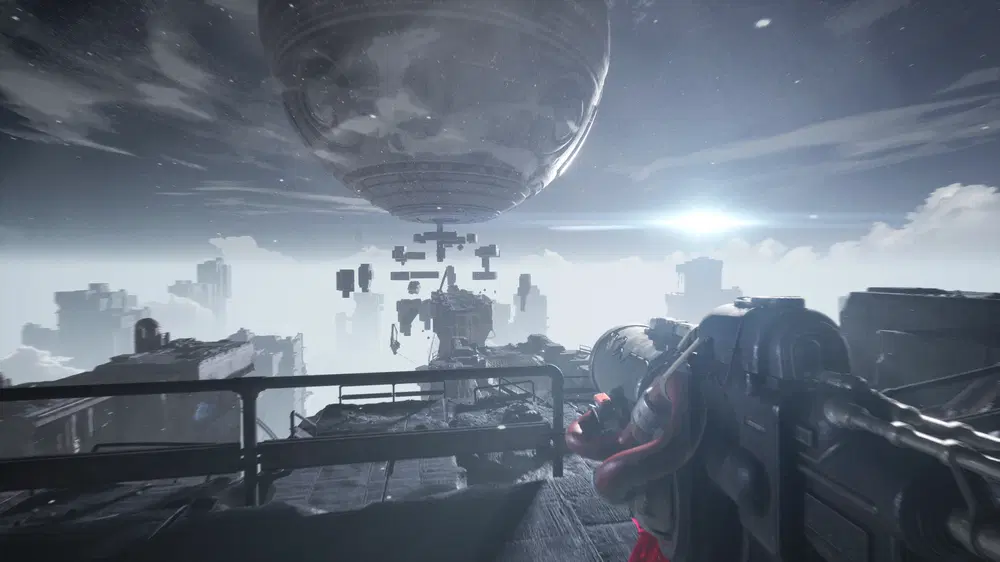
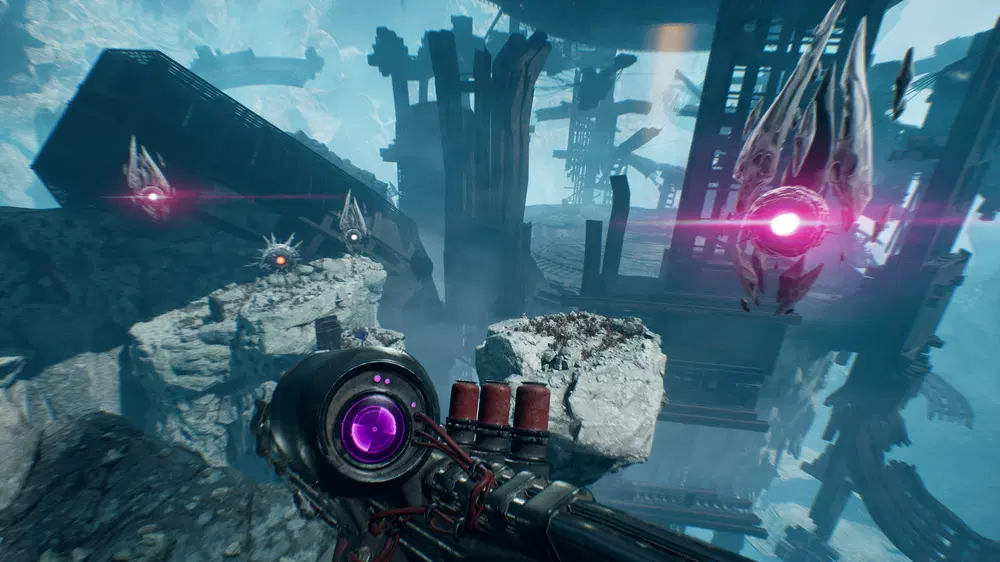
I’ve reviewed well over a thousand games over my career, and in many ways that’s sort of numbed me to the impact of even a really solid vista or well-presented bit of lighting. I can appreciate it, but rarely will I actually stop to just… gawk. Luna Abyss had me doing it with more frequency than anything short of those aforementioned Destiny games.
There’s a moment fairly early on where you’re forced to slide down a steep wall and it just… keeps… going. The game’s ability to showcase dank, claustrophobic areas early on and eventually you spill out into literally impossible “outdoor” areas with the same sense of infinite stretch. Things disappear into fog way off in the distance, but it’s so far out that it doesn’t feel like the draw distance is being cheated; something that far away is just bound to be obscured by haze.
On PS5 Pro, at least, all that scale is delivered with a rock-steady 60fps, but to be honest there’s a definite feeling of underlying math powering a lot of the architecture. You’ll see the same object and structures mixed and matched (though most are unique to their own sections of the game) in a way that sort of feels procedural, even if it’s all hand-crafted. Again, it harkens back to Housemarque’s work with Saros and Returnal, and there’s just an unshakable demoscene quality to some of these absolutely epic volumes that you find yourself dwarfed by.
The actually bits you’ll traverse are of course pretty tight, though that does bring up the question of why the game has so many old-school loading pauses. Pains are taken to normally hide truly long distances (in the instances where sight lines are long enough, you can actually see lighting popping into existence), so it feels odd that there wasn’t the same urge to just stream contents while things are obscured. It never gets in the way of gameplay, but it definitely feels anachronistic for games in 2026.
Nice Pipes
Right from the opening cinematic with its slow pan down and rising, sustained choir chants, it’s obvious composer David Housden wanted to make the game as aurally volumetric as the visuals. Simply put, Luna Abyss has amazing music:
Typically, you’re fed some fairly light choral backing with minimalist, throbbing bass punctuation that crops up during more light puzzle solving moments, but as you approach multiple awe-inspiring ones like the mines, the choir can become almost deafening in their intensity (it should be noted this slow build was done seamlessly while moving closer and closer to the level’s big reveal over the course of a good 20 minutes in a way that was simply sublime). Similarly, when something more inspiring happens, like your first rail ride, it’s an earnest, driving, string-powered accompaniment to a fun rollercoaster – a genuine release of joy after hours of bleak, choking decay.
During combat things obviously ramp up (again, in dynamic fashion) and down, adding layers of more thumping percussion and adding in more of a driving main theme to add zest to fights (and on boss battles, all of these elements have their sliders cranked to 11, though you’ll be too busy dodging bullets to notice). It’s a testament to just how nail-biting some of the encounters can get that in the thick of things, I felt the music more than I heard it, snapping back to actually hearing things only as the final stingers of a combat sequence trail off and blend back into the ambient loops. As that video above makes clear, though, there was serious effort put into blending literal human voices with things that feel both organic and mechanic.
A Tragic End
So here’s where we get to the bad news: the development team that made this game doesn’t exist anymore. Though the project was in development for a good seven years (most of which was done as an independent developer), the game was effectively rescued by Kwalee Games, turning erstwhile developer Bonsai Collective from a collective on the edge of bankruptcy into Kwalee Labs.
Despite bearing the name of the parent company, less than a month after Luna Abyss finally shipped, the studio was laid off. Being recently unemployed myself, the sting of a fate like that isn’t lost on me, but I was struck by something more while playing through this interactive epitaph: after creating something this good, the fact that these particular people will have their collective knowledge and insights diffracted out and will never get the chance to follow up is just crushing.
It’s more than just a bunch of people losing their jobs – these particular people aren’t going to be able to create something like this again, and when you play the game (and you absolutely should), the derelict environments all take on that much more of a mournful quality. It’s hard not to see yourself as someone traipsing through the grave of a studio, and it really does feel tragic in the most literal sense of the word.
Ironically, Toaplan, that Japanese studio that helped birth bullet hell games as a subgenre? Yeah, Batsugun was their last game too.
I’ve mentioned the joy I discovered in my previous professional work when being sort of forced to play stuff I never would have just because it was a review that came in.
This one was different.
Luna Abyss was something I saw, downloaded, and fired up completely on a lark. No assignment, no requirement, no impetus other than “huh, I wonder what this is about.” It was the purest kind of organic discovery. Despite not being forced – or perhaps because it wasn’t – it filled me with the same sense of gratitude that this medium can bestow on those rare occasions when a particular game connects with a particular person that I so cherished when reviewing games for a living.
Though they won’t have a chance to benefit from it (parent company Kwalee Games doesn’t even list the game on their own site, which feels especially cruel), I hope you give the game a chance and spend a little time in Bonsai Collective’s graveyard too.